“Little time left to wake up: Can we reconcile Europe with speed?”
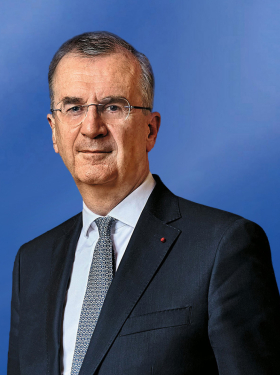
François Villeroy de Galhau, Governor of the Banque de France
Published on 27th of March 2026

Eurofi – 27 March 2026
Speech by François Villeroy de Galhau Governor of the Banque de France
Ladies and Gentlemen,
This Eurofi is especially meaningful to me, as it will be my last as Governor of the Banque de France; after 18 meetings in which I have had the privilege to participate, thanks to David Wright and Didier Cahen. I will therefore take this opportunity to express my gratitude to Eurofi and perhaps express myself even more freely today. Like all of you, I deeply regret not being able to meet in person in Cyprus. From Cyprus, birthplace of Zeno of Citium, the founder of Stoicism, comes a timely lesson: we need lucidity about what we cannot change, and determination regarding what we must change. The conflict in the Middle East, which I will not address directly this morning, is one reason more to act stronger and faster.
Let me be straightforward: we Europeans don’t have much time left to wake up. The question is not the “What?”: we Europeans already know what needs to be done (I). The real question is “How?”, and even more so “How fast”: why are we so slow in delivering? Can we reconcile Europe with speed? (II).
I. We Europeans know what needs to be done
1. A shared diagnosis: the Draghi-Letta consensus
Over the last 25 years, GDP per capita has increased by a cumulative 31% in the euro area, lower than the 47% in the United States. The main cause is our “Schumpeterian” innovation gap.i Yet Europe does not lack savings: the euro area household saving ratio stands at more than 15% of gross disposable income, against 11% in the United States.

But it lacks equity capital, which is essential to finance breakthrough innovation and risk-taking. Equity financing of non-financial corporations amounts to only 85% of GDP in the euro area, compared with 220% in the United States. The diagnosis is all too well-known to European companies and investors: while they identify market fragmentation (32% of respondents in the annual European Investment Fund Equity Surveyii) and access to capital (21%) as the key obstacle to scaling up EU firms, only 3% point to a lack of talent.

Furthermore, while total investmentiii (as a share of GDP) in the euro area is almost the same as in the US, productive investment – without construction – is much lower (10.5% of GDP in the euro area compared with 14.3% in the US) and still more so in innovative investment.iv

And let me sum up the cumulated 548 pages of the Lettav and Draghivi reports with three imperatives, three i’s we all agree upon. First, integrate more the single market, notably with the creation of an optional 28th regime by 2028.vii Second, invest better: this is the Savings and Investments Union.viii Third, innovate faster, and, for that, dare and simplify.

2. Europe’s awakening is slowly taking shape
Some progress has certainly been made over the past year: as of January 2026, 39% of the Draghi report recommendations were totally or partially implemented.ix
And let me mention just three recent examples:
- In 2025 alone, the European Commission presented 10 Omnibus simplification packages,x which could reduce recurrent administrative costs by EUR 11.9 billion.
- The Savings and Investments Union is not just a rebranding, but a more strategic way to unite banking and capital markets objectives – with first concrete proposals on centralized supervision, retail investment and insolvency law.xi
- Europe has also built on the successful precedent of common EU bond issuance, with the adoption of SAFExii in May 2025, which will provide up to EUR 150 billion in joint borrowing for defence investments.
II. Why are we too slow?
These are encouraging steps, and Europe is witnessing a new convergence around “strategic autonomy” or “economic sovereignty”, whatever you want to call it. Yet implementation remains too slow and too conventional – especially when compared with our competitors, be they the US or China. Many of our fellow citizens are raising this question of speed. Let me examine four possible candidates for explanation.
1. Strategic convergence but technical disagreements?
Our strategic convergence may still be superficial: what looks like a broad consensus masks many technical disagreements, when we go from the broad political agreement to the detailed administrative work. And in parallel, we are still struggling to embody the Letta and Draghi agenda into a few concrete and politically attractive projects. As Jacques Delors used to say: “you do not fall in love with a Single Market” – and, let us be honest, nor do you fall in love with a Savings and Investments Union. But this is the means to deliver three concrete European priorities: AI, decarbonised energy – all the more so after the Iran war – and defence.
Moreover, our European culture and reflexes too often favour caution and incrementalism over breakthrough changexiii – both in our investment habits and in our institutional choices. Europe fears the risks of action, whereas America fears the risks of inaction. But the success of Denmark, the Netherlands and Sweden show us that economic growth and social values can go hand in hand. And this is a “dare or die moment”. Crises can either make Europe – or unmake it, depending on our collective will to overcome them.

2. Our governance remains too cumbersome?
Europe has shown in the past that it can turn crises into progress. The global financial and sovereign debt crises led to major advances: from the European Stability Mechanism to the Banking Union, alongside decisive action by the Eurosystem. Europe has, even recently, shown its ability to act swiftly: after Russia’s invasion of Ukraine in 2022, with sanctions packages adopted in real time, and several major support instruments for Ukraine decided on in quick succession,xiv at a time when the additional US packages were delayed by congressional discussions. The EU has also moved faster than the US in our Markets in Crypto Assets Regulation (MiCAR)xv, two years before the GENIUS Act.
But today’s geopolitical crisis has not yet triggered the same acceleration. Our governance remains too cumbersome. The challenge is not to choose between democratic legitimacy and speed, but to reconcile both. Too often, each European actor plays too much of an individual game, adding its own delays, when what we need is to step up our collective game.
In the economic field, unanimity fortunately remains the exception rather than the rule, being still a real obstacle in taxation, hindering the SIU, or sanctions and key support instruments to Ukraine. But slowness is not only a matter of voting rules. It also depends on early and bold initiative by the Commission, how quickly the Council and the European Parliament align, and which legislative instrument is chosen. Let us not repeat the delays of the digital euro, where we will possibly need 35 months between the initial proposal of the Commission and the final vote of the European Parliament. Where a truly common framework is needed, regulations – which are directly applicable throughout the Union – can offer greater speed, clarity and unity. The regulation proposed by the Commission on the 28th regime,xvi or “EU Inc.”, is a positive example. It is now for the European Parliament and the Council to match this ambition with the same sense of urgency.
This leads to a broader question: should our Europe move towards deeper integration? A general federal leap is clearly out of reach. But we may need, to borrow Mario Draghi’s seminal speech in Louvain,xvii a form of “pragmatic federalism” in some strategic areas, with stronger common instruments and decision making powers following the Euro example – from defence to energy, technology and financial integration.
3. The relevant geographic scope?
This consideration leads us to our third candidate for slowness: the geographic scope. Too often, European unity means that all 27 Member States must move together, at the same pace. But this search for completeness can become a source of inertia. In some strategic areas, Europe should be able to rely on coalitions of willing Member States.
Some may question whether Europe can truly make differentiated integration work. After all, enhanced cooperation has been provided for since the Treaty of Amsterdam (1997), and it has almost never delivered in practice. Yet the euro itself provides the clearest example. Over the past 27 years, Europe has established its monetary sovereignty through the euro – a major popular success, supported by 82% of European citizens.xviii And it was built through gradual integration, starting at 11 in January 1999, with Bulgaria becoming the 21st member in 2026. But the euro teaches us a second valuable lesson: variable geometry only works when a policy is anchored in a single strong and specific institution, entrusted with democratic accountability on a clear mandate and sufficient independence to ensure efficiency – the ECB,xix together with the Eurosystem.
4. A mobilising deadline
Finally, we still miss a credible calendar. Our economic and financial sovereignty can only be achieved if it meets one key condition, an alignment of three stars: political goals, administrative work, and corporate business. As a famous saying attributed to Walt Disney goes, “The difference between a dream and a plan is a completion date.” This is even more necessary today as the American dream of many European businesses has weakened, amid the growing unpredictability of US policy. Europe must now offer a credible counterproject of its own.
To this end, I call for a mobilising deadlinexx, as Jacques Delors did in the past with 1 January 1993 for the single market, and 1 January 1999 for the single currency. The exact date can be discussed. But it should fall within the “Trump years”. Why not 2028 – 35 years after the Single Market? Or 1 January 2029 – 30 years after the euro?
May I conclude with one sentence I heard very often in the past year in this new global order – or disorder – from our non-European colleagues – be they from advanced or emerging economies: “You Europeans have a unique opportunity; don’t waste it.” So far, the jury is still out… but the window of opportunity is about to close. Let us stabilize the roadmap along a practical matrix, like the one proposed by Enrico Letta in February.

But let us definitively change speed, combining three levers: a team-playing European governance, flexible geographies when needed, and one single mobilizing deadline.
Allow me a personal recollection, as a long-standing actor of the euro: sometimes, the line between success and failure comes down to very little. During the EMS crises of September 1992 and July 1993, and again during the euro crisis in the summer of 2012, it took – and it was enough – the cool heads and courage of a few men, from Jean-Claude Trichet and Hans Tietmeyer to Mario Draghi. Today, we stand before that same line between success and failure, and we bear that same responsibility before history. Thank you for your attention.
i Villeroy de Galhau (F.) (2021), “Europe’s growth gap: reconciling Keynes and Schumpeter | Banque de France”, speech at the College of Europe, 31 March.
ii European Investment Bank (EIB). (2026). EIB Investment Report 2025/2026. 3 March.
iii Measured as the volume of gross fixed capital formation (GFCF).
iv calculated as the sum of investment in ICT, software, databases and research and development.
v Letta (E.) (2024), Much more than a market, April.
vi Draghi (M.) (2024), The future of European competitiveness, September.
vii Coste (O.), Coatanlem (Y.) (2024), "The Cost of Failure and the Quest for Competitiveness: Disruptive Innovation as a Catalyst”. IEP Policy Brief n 24, IEP Bocconi.
viii European Commission (2025), “SIU strategy to enhance financial opportunities for EU citizens and businesses”, 19 March.
ix European Policy Innovation Council (2026). The Draghi Observatory Implementation Index Update (DOII-Interim-Audit-_Jan-2026_web.pdf). January.
x European Commission (2026). Simplification - European Commission
xi European Commission (2025). EU insolvency law: member states agree position on bringing national insolvency standards closer - Consilium
xii European Commission (2025), SAFE | Security Action for Europe - European Commission
xiii Villeroy de Galhau (F.) (2025), “Venturing into open waters to unlock Europe’s innovative potential | Banque de France”, speech at Euronext Paris, 18 March.
xivThe delayed implementation of the EUR 90 billion Ukraine Support Loan (USL) contrasts with the rapid adoption of previous EU support instruments for Ukraine: the EUR 18 billion Macro-Financial Assistance Plus (MFA+) programme adopted in December 2022 for 2023; the EUR 50 billion Ukraine Facility for the 2024-27 period adopted in February 2024; and the EUR 18.1 billion MFA programme financed by revenues from immobilised Russian assets, adopted in October 2024.
xv Markets in Crypto-Assets Regulation (MiCA)
xvi EU Commission (2026). Regulation of the European Parliament and of the Council on the 28th regime corporate legal framework – ‘EU Inc.’. 18 March.
xvii Draghi (M.) (2026), “Europe cannot remain a loose confederation of states”, speech at the Catholic University of Louvain, 2 February.
xviii Standard Eurobarometer 104 - Autumn 2025 - décembre 2025 - - Eurobarometer survey
xix On the notion of independent institutions acting as “trustees” of credible collective commitments in EU governance, see Majone (G.) (2001), “Two Logics of Delegation: Agency and Fiduciary Relations in EU Governance”, European Union Politics, Vol. 2, No. 1, pp. 103-122.
xx Villeroy de Galhau (F.) (2025), “A mobilising deadline for seizing “Europe’s moment””, speech, 14 May.
Download the full publication
Updated on the 27th of March 2026