
“Despite the geopolitical uncertainty, we must continue to address the challenges facing the French economy. The Banque de France will assume all of its responsibility in this process as an anchor of stability and trust.” François Villeroy de Galhau
Inflation is under control but challenges remain
The Eurosystem – of which the Banque de France is a member – succeeded in bringing inflation back to target in 2025. Helped by a credible monetary policy, inflation fell to well below 2% in France and to close to 2% in the euro area, in line with the Eurosystem’s price stability objective. The victory over inflation was achieved without triggering a recession, and despite an exceptionally uncertain environment. The commitment and clear communication of all Eurosystem central banks were essential in securing this outcome. The disinflation process allowed four interest rate cuts to be made in 2025 – in addition to the four implemented in the second half of 2024 – bringing the main key rate down to 2% by the end of 2025. As a result, financing conditions continued to improve.
French growth remained resilient in 2025, despite a volatile and unpredictable international backdrop. Customs tariffs and the uncertainty surrounding them caused sharp fluctuations in economic activity in the first half of the year. The signature in July of a trade agreement between the United States and the European Union – which increased tariffs on euro area exports to the United States – helped to lift some of the uncertainty. Household consumption remained subdued as political and fiscal uncertainty encouraged consumers to save. In this context, French GDP grew by 0.9% in 2025, after expanding by 1.1% in 2024.
Payment methods are continuing to evolve in line with changing consumer habits. In 2025, the growing use of innovative payment solutions fuelled further rises in the use of cashless payment instruments, while cash usage continued to decline. In response, the Banque de France has restructured its cash centre network, moving to a “one centre per region” model which should remain stable for the next decade. Nevertheless, cash will remain an essential component of France’s payment ecosystem, justifying the construction of a new printing works and the launch of a new series of euro banknotes. The total value of payment fraud stabilised at an all-time low, thanks to efforts to prevent risks and raise awareness among users. Finally, the digital euro project – conceived as a “digital banknote” enabling payments in central bank money – entered a new phase of development.
+0,9 %
French GDP growth in 2025
0,7%
HICP inflation in France to the end of December 2025
In an unpredictable world, the French financial system remains resilient
In an unpredictable international environment, the French financial system is exposed to a heightened risk of external shocks, while uncertainties surrounding the country’s fiscal trajectory have rekindled the threat of an internal shock.
Banks and insurers remain in a strong financial position. The stress tests run by the European Banking Authority (EBA) and the European Central Bank (ECB) show that they have excellent shock-absorbing capacity. Moreover, the Banque de France and the Autorité de contrôle prudentiel et de résolution (ACPR – Prudential Supervision and Resolution Authority) are collaborating with the Autorité des marchés financiers (AMF – Financial Markets Authority) on the first edition of a system-wide exercise.
The macroprudential measures adopted by the Haut Conseil de stabilité financière (HCSF – High Council for Financial Stability) support the ability of the French financial system to cope with the identified vulnerabilities. In 2025, the HCSF kept the countercyclical capital buffer at 1% and maintained measures governing the approval of loans for house purchase.
The Banque de France and the ACPR are working to ensure that financial players take better account of the risks associated with climate change, the degradation of nature and the digitalisation of finance. They play an active role in the work of the Network for Greening the Financial System (NGFS), for which the Banque de France serves as secretariat.
The growing digitalisation of the economy and of the financial system poses risks to financial stability and monetary sovereignty. Stablecoins and tokenisation are on the rise, while the use of artificial intelligence is becoming widespread. In response, the Banque de France is contributing to efforts to develop a central bank digital currency. Since January 2025, it has applied the Digital Operational Resilience Act (DORA) – the European regulation to strengthen the digital operational resilience of the financial sector – and has coordinated a market-wide exercise simulating cyberattacks.
The ACPR monitors business practices and combats money laundering. In 2025, its work on customer protection focused primarily on products and distribution models that do not take sufficient account of customer interests.
146
on site inspections of insurers and banks
15,7%
Common Equity Tier 1 capital ratio of the six main French banking groups
Banque de France services for businesses and individuals
In 2025, the Banque de France strengthened its support for businesses by deploying simplified and more customised tools. Around 60,000 company directors now regularly use their online Manager Portal to check their ratings and access financial analyses. The climate indicator was extended to two new sectors (cement and building construction), adding to the three included in 2024 (power generation, transport and real estate). As a result, around 14,000 businesses now benefit from a tool to help manage their climate transition. Also in 2025, the 102 VSE-SME correspondents across the branch network assisted 9,182 project leaders and company directors, while the start-up correspondent network helped over 300 entrepreneurs to secure financing. Applications for credit mediation declined slightly in 2025 compared with 2024.
The Banque de France stepped up its efforts to improve financial inclusion for individuals in 2025. Online filing for debt resolution was extended to co-applicants, while the procedure for applying for a basic bank account was made fully digital. In total, the Bank processed 142,670 requests for a basic bank account over the year and ordered 23,288 accounts to be opened.
As the national steering body for France’s financial education strategy (EDUCFI), the Banque de France trained 35,808 social workers in 2025, notably through a collaboration with the National Prison Service and the National Agency for Combating Illiteracy. Nearly 350,000 students, including some attending vocational high schools, were awarded an EDUCFI “passport” during the year. Moreover, the website for the ABC de l’économie collection – aimed at high school and university students as well as anyone interested in the economy – was completely modernised and now offers 110 free educational resources. In parallel, the Cité de l’économie, or Citéco museum, welcomed more than 100,000 visitors in 2025.
The Banque de France provides financial services to the state, notably by managing the Treasury’s bank accounts and all related payment flows. Since 2021, it has been responsible for conducting auctions of short-term debt securities on behalf of the European Commission, to finance Europe’s NextGenerationEU recovery plan.
277000
non-financial corporations (mainly SMEs) assigned a Banque de France rating
350000
students were awarded an EDUCFI “passport” during the year
Download the PDF version of this document
Read the Annual Report
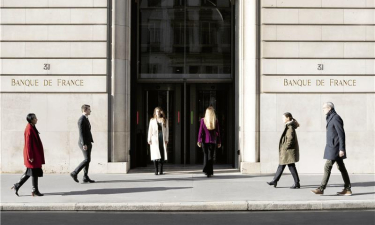
Banque de France Annual Report 2025
The Annual Report describes the action taken by the Banque de France over the year to fulfil its three core missions: monetary strategy, financial stability and services to the economy and society. It presents the work of the women and men that make up the Bank’s staff, placing particular emphasis on corporate social and environmental responsibility. The final section provides details of the Bank’s financial management and its financial statements for the year.
Updated on the 24th of September 2026