
Macroeconomic interim projections – September 2026
In order to contribute to the national and European economic debate, the Banque de France periodically publishes macroeconomic forecasts for France, constructed as part of the Eurosystem projection exercise and covering the current and two forthcoming years. Some of the publications also include an in-depth analysis of the results, along with focus articles on topics of interest.
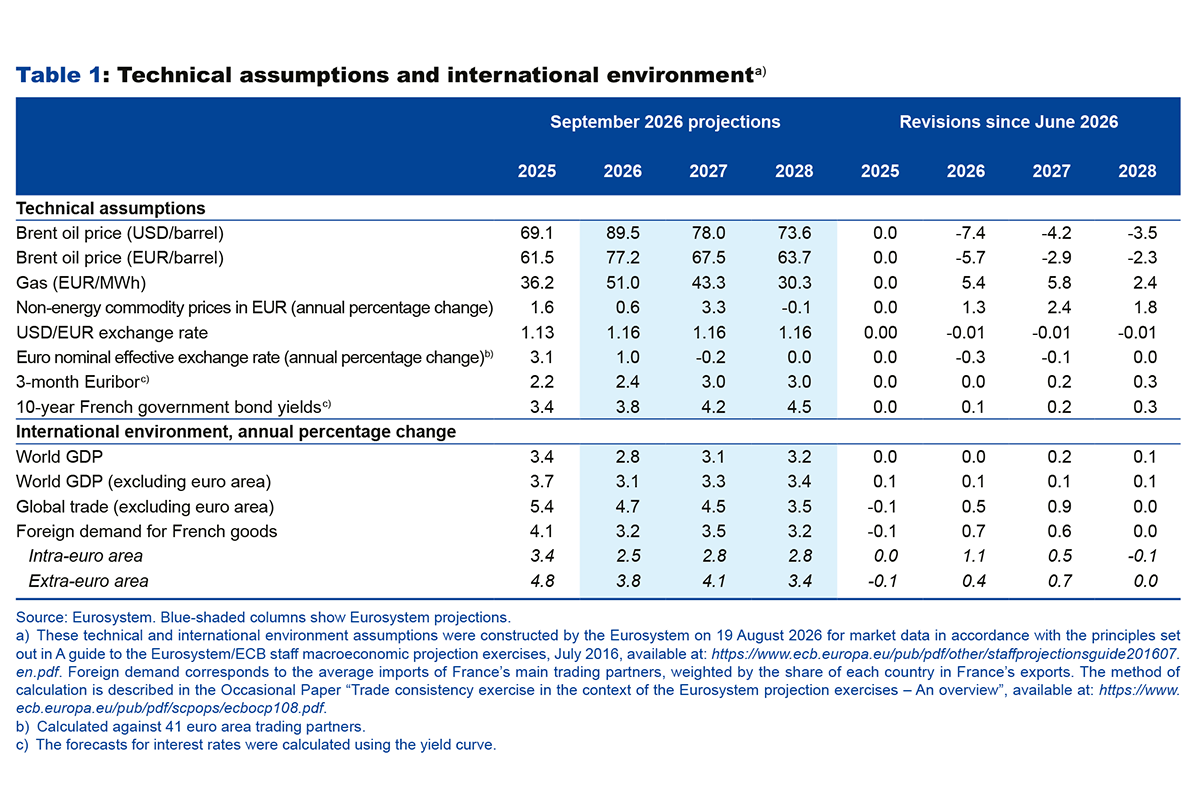
- These macroeconomic projections were drawn up in an uncertain international environment, still dominated by the ongoing conflict in the Middle East. In this context, as in our June projections, we present several scenarios characterised by different future trajectories for energy prices that are consistent with those published by the European Central Bank (ECB) for the Eurosystem on 10 September 2026. Our baseline scenario is based on assumptions derived from the futures markets as at 19 August 2026. Under this scenario, oil prices should fall in the third quarter of 2026 and continue to decline over the projection horizon, whilst remaining above the level observed at the end of 2025. By contrast, gas prices should continue to rise as winter approaches, before trending downward from mid-2027 onwards.
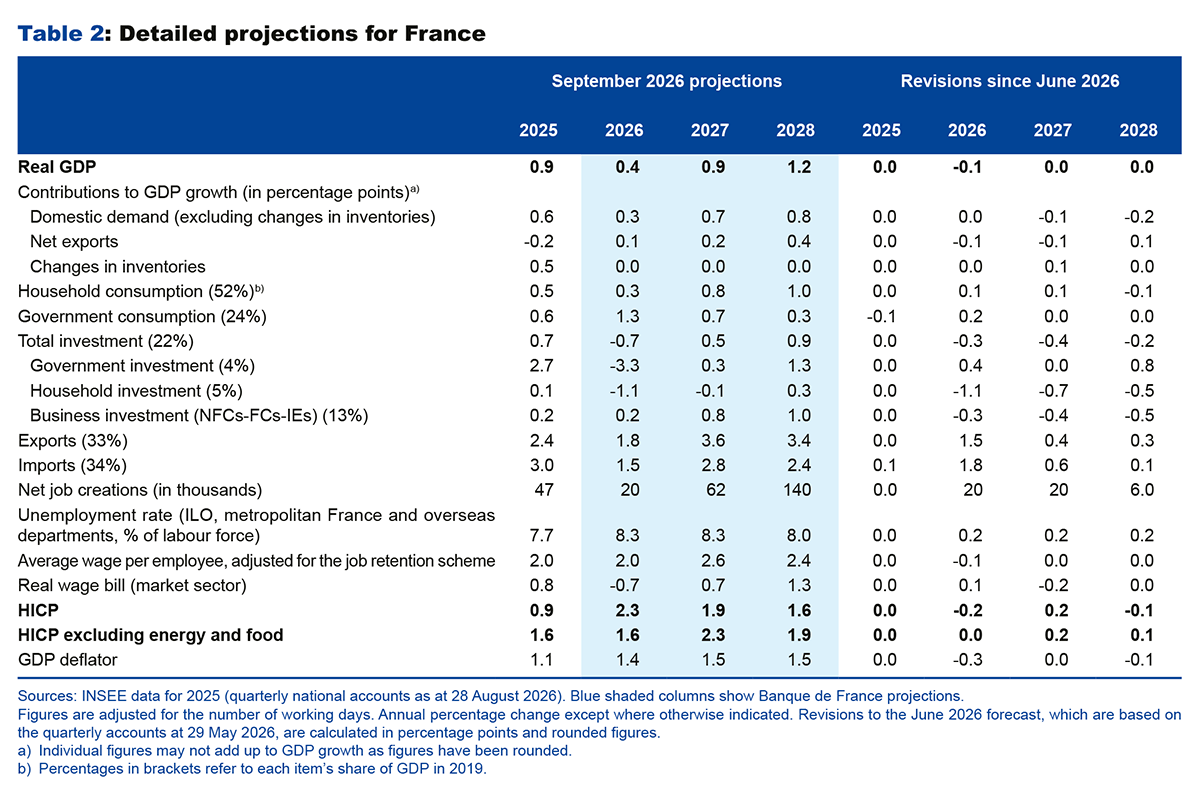
- According to our projections, GDP growth is expected to come in at 0.4% for 2026. This figure has been revised downwards by 0.1 percentage point compared with our June projections. It should then climb to 0.9% in 2027 and 1.2% in 2028, driven by firmer domestic demand. Economic activity should also benefit from strong export performance in a context where global trade is proving resilient despite a succession of shocks that are likely to disrupt international trade. However, private investment is likely to remain constrained by tighter financing conditions and uncertainty surrounding fiscal policy.
- After averaging 0.9% in 2025, headline inflation is expected to rise to 2.3% in 2026 before falling back below the 2% target, coming in at 1.9% in 2027 and 1.6% in 2028. The downward revision to headline inflation for 2026 compared with our June projections is mainly due to oil prices being lower than forecast in our previous projections, and to recent downward surprises in inflation for processed food and services. Conversely, headline inflation has been revised slightly upwards for 2027, due to higher-than-expected refining margins in June and the impact of rising gas prices and weather events on food and electricity prices. Inflation excluding energy and food is expected to remain stable at 1.6% in 2026. It is then projected to increase to 2.3% in 2027 on account of indirect and second-round effects of the rise in energy prices, before falling back to 1.9% in 2028 as the impact of these shocks subsides.
- The unemployment rate is expected to continue rising in the short term, reaching 8.4% by the end of the year, before declining to 8.0% in 2028. Compared with our June projections, it has been revised upwards across the entire projection horizon, reflecting a slightly worse starting point in the second quarter and a more dynamic labour force than forecast in June.

This projection is based on Eurosystem technical assumptions, for which the cut-off date is 19 August 2026 (see Table 1 in the Appendix). It also incorporates the final figures of the Harmonised Index of Consumer Prices (HICP) for July published on 14 August, and the detailed results of the second quarter 2026 national accounts published on 28 August. The 2026 fiscal assumptions have essentially been updated to reflect the credit freezes announced in July, while the conventional assumptions regarding the primary structural adjustment for 2027 and 2028 remain the same as in June.
Growth is expected to be moderate in 2026 before rebounding in 2027 and 2028
According to the detailed results published on 28 August, economic activity in France was sluggish during the first half of the year. After declining by 0.2% in the first quarter, GDP remained stable in the second quarter. This stability is mainly attributable to weak growth in market services, the persistent downturn in the construction sector and the initial effects of the heatwave on agricultural output. Against this backdrop, only manufacturing and non-market services buoyed economic activity in the first half of the year. In the third quarter, economic activity is expected to grow by 0.1% according to the results of the monthly business survey conducted in early September, as forecast in our June projections. Although growth rates for the second and third quarters remain unchanged compared to these projections, we have revised our annual growth forecast for 2026 downwards to 0.4%. This revision is due in particular to a first-quarter growth rate that is 0.1 percentage point lower than that in the national accounts published on 29 May, which had formed the basis for our June projections.
For 2026 as a whole, the weak growth in household consumption is expected to weigh on economic activity (see Chart 2), even though households drew down their savings in the second quarter to mitigate the effects of the inflationary shock caused by the conflict in the Middle East. Private investment is expected to be even more sluggish, held back by the decline in residential investment in the first half of the year and by businesses’ wait-and-see approach to capital expenditure, with the exception of spending on intangible assets. The contribution of foreign trade to growth is likely to remain limited, despite the recovery in exports from the second quarter onwards, particularly in the aeronautics and defence sectors. Agricultural exports are likely to be impacted by this summer’s heatwave, as happened during other droughts in recent decades.


Economic activity is then expected to pick up in 2027 and 2028, registering growth rates of 0.9% and 1.2% respectively. Although household confidence remains at a relatively low level, against a backdrop of upcoming budgetary deadlines and elections, consumer spending is expected to be buoyed by a gradual improvement in the purchasing power of wages. This trend should be underpinned in particular by the fall in energy prices factored into the technical assumptions of the baseline scenario. Foreign trade should also help drive growth during these two years, insofar as global demand for French goods and services is expected to remain more buoyant than
domestic demand.
Compared with our June projections, GDP growth has been revised downwards for 2026 and remains unchanged for the rest of the projection horizon (see Chart 1). Historical revisions to the national accounts are weighing on the growth forecast for 2026. This effect is only partially offset by an upward revision of the purchasing power of wages, thanks to lower-than-expected inflation over the last few months. The impact of the revisions on the technical assumptions compared with those used in June appears mixed. On the one hand, demand for French goods and services from the rest of the euro area is stronger than forecast in June (see Table 1). On the other hand, the upward revision to global demand from countries outside the euro area, and that of foreign competitors’ prices, is only partially factored into our projections. Part of these revisions reflects the boom in international trade in products associated with artificial intelligence (semiconductors, specialised IT equipment, etc.), whose knock-on effects on the euro area economies remain limited. Furthermore, the upward revision to long-term interest rates is expected to gradually feed through to the financing conditions for households and businesses, thereby weighing on their investment decisions.
As in the June projections, the risks surrounding our growth scenario remain tilted to the downside over the projection horizon. The ongoing conflict in the Middle East and its impact on energy prices continue to generate considerable uncertainty (see box).
Inflation is expected to ease after 2026 despite rising service prices
According to INSEE’s provisional estimate, headline inflation, as measured by the Harmonised Index of Consumer Prices (HICP), rose again to 2.7% year-on-year in August 2026, up from 2.4% in July. Inflation excluding energy and food should remain stable at 1.4% year-on-year in August.
In 2026, headline inflation (HICP) is forecast to average 2.3%, after 0.9% in 2025 (see Chart 3). It is expected to be driven mainly by energy prices, reflecting the impact of the conflict in the Middle East on oil and gas prices and refining margins (see Chart 4). Food inflation should remain moderate, at 1.6%, despite the impact of recent weather conditions on fresh produce prices. Meanwhile, inflation excluding energy and food is expected to average 1.6%, held down by manufacturing prices that are continuing to decline slightly, whilst service prices are expected to
edge up.


In 2027, headline inflation is expected to fall to an annual average of 1.9%, due to the gradual normalisation of energy prices, as set out in the technical assumptions, while the past rise in energy prices would continue to feed through to other components of inflation. Food inflation is forecast to rise to 2.3%, driven by the gradual pass-through of past increases in production costs and the delayed impact of recent weather events on agricultural prices. Inflation excluding energy and food is also expected to rise to 2.3%, driven mainly by services as a result of wage growth, while manufactured goods prices should increase as a result of higher import prices. In 2028, headline inflation is forecast to drop to 1.6%, following the normalisation of energy prices in line with technical assumptions. Meanwhile, inflation excluding energy and food is projected to fall to 1.9%, notably due to a slowdown in services prices in the wake of wage moderation.
Compared with our June projections, headline inflation has been revised downwards by 0.2 percentage point for 2026. This revision stems from a smaller-than-expected rise in crude oil prices, in line with the Eurosystem’s technical assumptions, and a more gradual pass-through of the indirect effects of energy prices to food prices. However, other factors are expected to push up our inflation projection for 2026, in particular refining margins. These remain at historically high levels, fueled by geopolitical tensions that are affecting global refining capacity (including the conflict in the Middle East and Ukrainian strikes against Russian oil infrastructure). For 2027, headline inflation has been revised upwards by 0.2 percentage point, on account of a less pronounced fall in energy prices and a delayed pass-through of cost increases to other components. Furthermore, high diesel refining margins are expected to continue to keep prices of refined petroleum products above the levels observed at the end of 2025. For 2028, our forecast for headline inflation has been revised downwards by 0.1 percentage point, mainly due to the fall in energy prices.
The purchasing power of wages is expected to decline in 2026, before picking up again in 2027 and 2028
Our projections of growth in average wage per employee have changed very little since our June forecast and stand at 2.0% in 2026, 2.6% in 2027 and 2.4% in 2028. It has been revised slightly downwards in 2026 due to revisions to historical data, but remains unchanged in 2027 and 2028. The average wage per employee is forecast to rise more slowly than prices between mid-2026 and early 2027, before catching up with, and then exceeding the cumulative increase in prices generated by the 2026 energy shock (see Chart 5).


The unemployment rate has been revised upwards over the entire projection horizon, due to both a higher starting point than anticipated in June (8.3% in the second quarter), and to an upward revision of our labour force projection. It is expected to average 8.3% in 2026 and 2027, before falling to 8.0% in 2028 (see Chart 6). As in our June projection, total employment is forecast to remain broadly stable in 2026, with growth in self-employment more than offsetting the decline in market sector salaried employment. It should pick up again in 2027 and 2028, thanks to the creation of market sector salaried jobs as activity recovers, while growth in self-employment slows down. Overall, growth in purchasing power of wages should return to a rate close to 1% in 2027 and 2028, following a marked decline in 2026 (by -0.7%).
Box
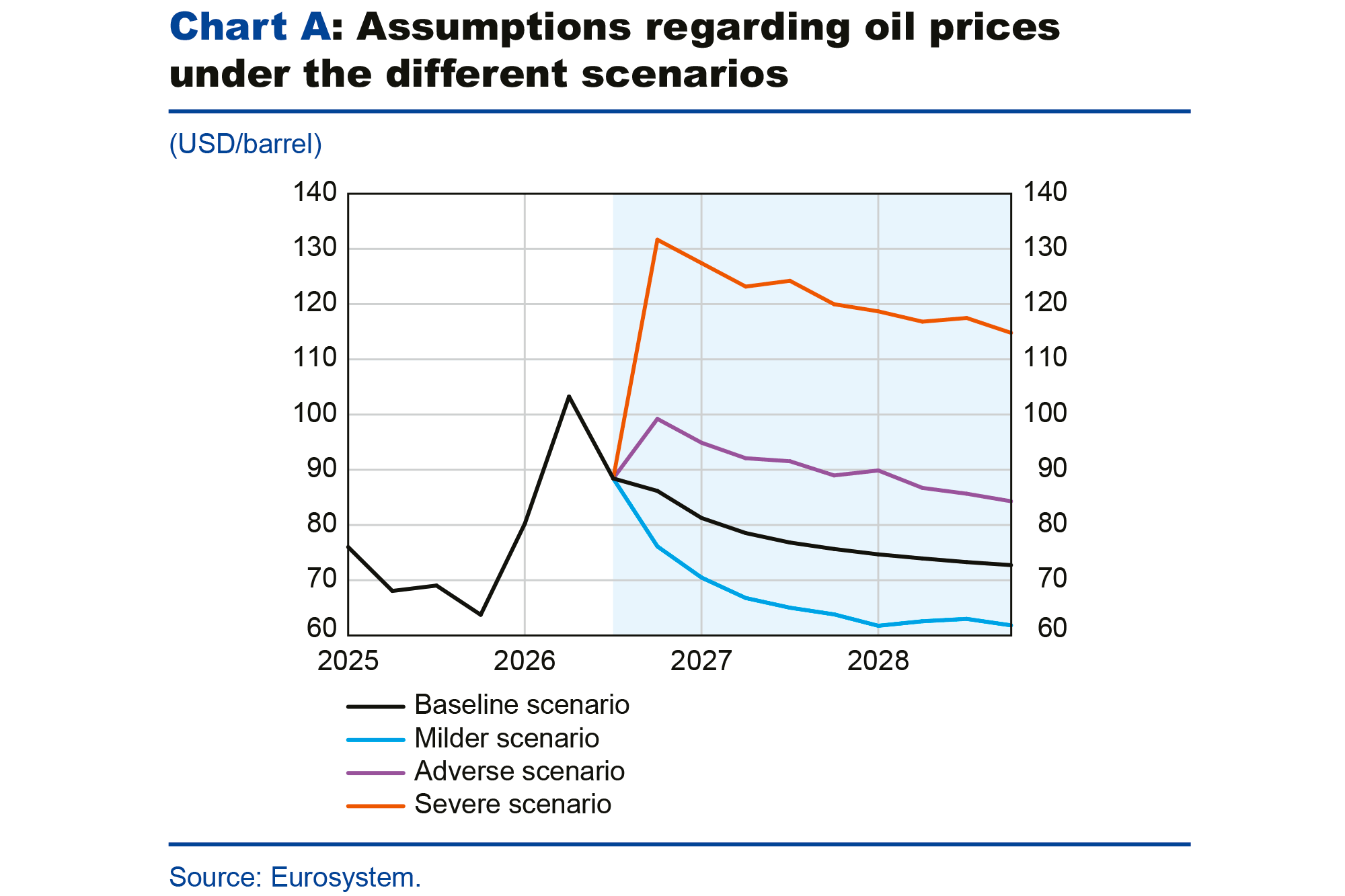
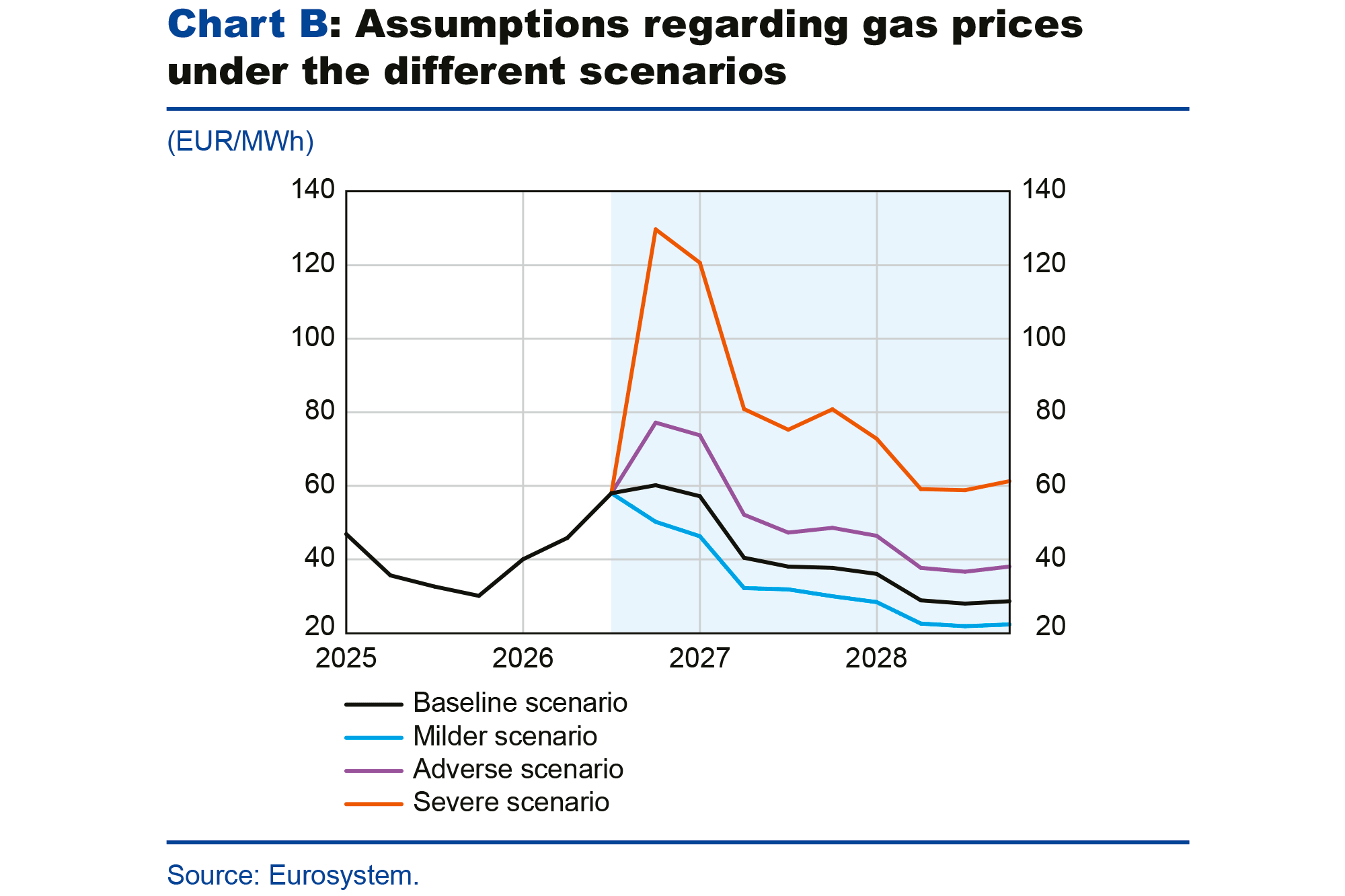
As in March and June, owing to the uncertainty surrounding the conflict in the Middle East, we present three alternative scenarios alongside the baseline scenario – two more adverse and one milder – based on the same assumptions as those used by the European Central Bank for the entire euro area. These scenarios differ in terms of the assumptions underlying the baseline scenario in three respects: (i) the different possible trajectories of energy prices (see Charts A and B), which implicitly factor in potential developments in the Middle East conflict and the consequences for energy supplies; (ii) the level of uncertainty; and (iii) the effect of these shocks on international trade. From a methodological standpoint, they are constructed in the same way as in June,¹ with a few differences. More specifically, all the shocks affect the French economy from the fourth quarter of 2026, rather than the third quarter under the June scenarios, thereby shifting a large part of their impact into 2027.
Compared with the June scenarios, the assumptions underpinning the severe scenario for oil prices are less pessimistic, with a peak of USD 132 per barrel in the fourth quarter of 2026, compared with USD 166 per barrel in the third quarter in June, reflecting less uncertainty regarding the impact of a prolonged conflict on global oil production. Conversely, the assumptions for gas prices are more pessimistic, with a peak of EUR 130 per MWh, compared with EUR 112 per MWh at end-2026 under the severe scenario in June, in light of the current low levels of strategic gas reserves in certain European countries.
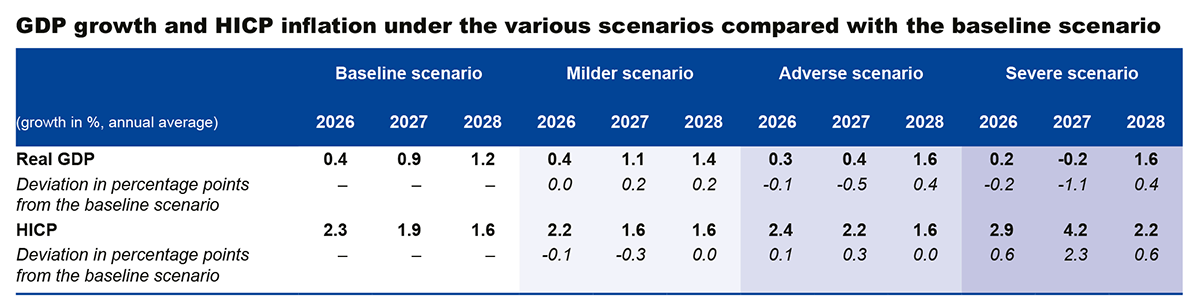
Under the adverse scenario, inflation would be 0.1 percentage point higher in 2026 and 0.3 percentage points higher in 2027 compared with the baseline scenario. The negative effects of the inflationary shock would be felt mainly in 2027: growth would be 0.4% in 2026 and 2027 before rebounding to 1.6% in 2028 as energy prices ease. Under this scenario, France would avoid a recession in both 2026 and 2027. Under the severe scenario, economic activity would slow down markedly towards the end of 2026 and early 2027, and growth would be slightly negative in 2027 (-0.2%) before rebounding in 2028 to 1.6%. Inflation would reach 2.9% in 2026 and 4.2% in 2027 before falling to 2.2% in 2028. Lastly, under the milder scenario, as in June, both activity and inflation would benefit from a more rapid easing of energy prices.
1 For more details concerning methodology, the reader should refer to the Box in our June 2026 Macroeconomic projections.
Appendix
Download the full publication
Updated on the 15th of September 2026